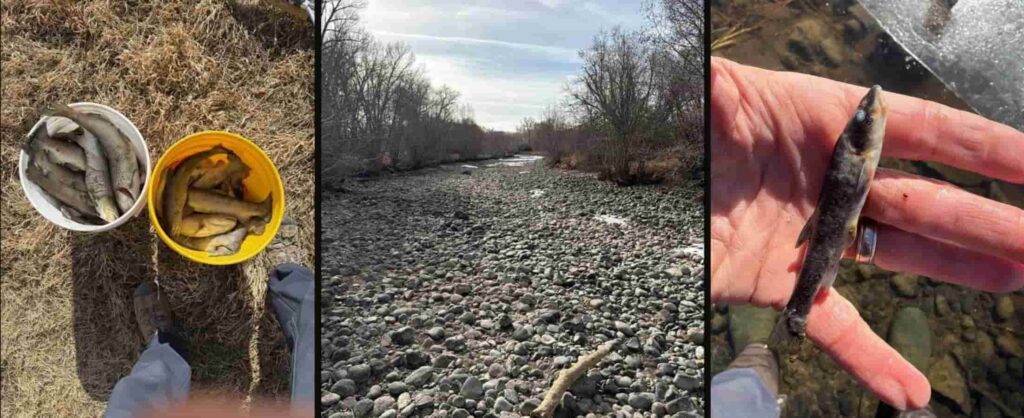

Building on a federally moneyed canal enhancement near Del Norte, Colorado, dewatered 7.2 miles of the river, eliminating trout and native fish throughout any age classes in numbers too big for a nine-person team to gather. Biologists state healing will take 3 to 5 years. Images thanks to CPW
Colorado Parks and Wildlife has actually validated a “massive fish kill” along the Rio Grande listed below Del Norte after a river remediation job dried up 7.2 miles of channel throughout a winter season cold wave. The kill erased brown trout and rainbow trout from 2-inch fingerlings to 24-inch grownups, in addition to native types that have actually lived in the upper Rio Grande for millennia.
The catastrophe comes from the Farmers Union Canal Diversion and Headgate Improvement project, which received $1.27 million through a Bureau of Improvement WaterSMART grant. The job– led by the Rio Grande Headwaters Restoration Project and the San Luis Valley Watering District– was created to change an aging diversion dam and headgates on the Farmers Union Canal, which bifurcates the Rio Grande into its north and south channels downstream of Del Norte. The brand-new facilities was expected to enhance watering effectiveness for 140 water users throughout approximately 43,000 acres while including fish and boat passage.
Rather, a building and construction choice dewatered the river’s north branch.
What Occurred
A landowner gotten in touch with CPW on February 3 to report that the north branch of the Rio Grande east of Del Norte was going dry and fish were passing away. CPW private investigators validated the dewatering was connected to the canal job. On February 16, a nine-person CPW crew walked the affected channel to gather dead fish. They lacked capability before they lacked carcasses.
” There were a lot of dead fish for the group to gather them all,” stated John Livingston, CPW’s southwest area public info officer.
Farmers acquainted with the job informed the Alamosa Citizen that a “rash choice” was made to press building and construction forward throughout a cold spell this winter season, drying the river through personal passages of the Rio Grande. Fast dewatering in subfreezing conditions left fish stranded in diminishing swimming pools, where they froze or suffocated. CPW stated scavengers– birds, raccoons, skunks, foxes– relocated before biologists might tally the complete toll.
Damage Beyond Trout
The kill extends well past the sportfish that draw anglers to this stretch. CPW’s examination recorded dead brook stickleback, longnose dace, fathead minnow, and white sucker. Northern leopard frogs and marine invertebrates– mayflies, caddisflies, stoneflies– likewise died.
The reach harbors an aboriginal population of Rio Grande chub ( Gila pandora), a Tier 1 Species of Greatest Conservation Need under Colorado’s State Wildlife Action Strategy and a state Types of Unique Issue. Historically the most typical fish in the Rio Grande basin, the chub has actually decreased significantly due to environment loss, water diversions, and predation by nonnative types. CPW and its partners have actually invested years working to prevent federal listing of the chub and the associated Rio Grande sucker– equipping almost 1.2 million chub into 11 waters considering that 2002. Losing an aboriginal population in the primary stem damages that effort.
The impacted stretch likewise acts as nesting and rearing environment for 2 federally secured bird types: the threatened southwestern willow flycatcher and the threatened western yellow-billed cuckoo. Neither overwinters in the reach, however both depend upon its riparian passage each spring and summertime.
Healing Timeline
CPW marine biologists approximate the fishery in this 7.2-mile area will require 3 to 5 years to recuperate. The kill removed numerous year-classes of trout, and brown trout eggs transferred in the riverbed gravel throughout last fall’s generate were more than likely lost. That loss substances the damage: the reach will not start producing its own wild brown trout hires till making it through or recolonizing fish finish a complete spawning cycle.
The afflicted reach lies simply downstream of the Rio Grande’s Gold Medal section in between South Fork and Del Norte– water CPW has actually designated for its trophy-caliber trout density and size. Fish relocation in between the 2 stretches, and the loss of numerous age classes listed below Del Norte might slow recruitment into the Gold Medal passage too. Anglers preparing journeys to the San Luis Valley this spring or summertime ought to anticipate decreased fishing around the impacted reach and might wish to concentrate on water well upstream of Del Norte till the population restores.
A Remediation Job’s Unintended Repercussion
The Rio Grande Headwaters Remediation Job has a strong performance history. Considering that its starting in 2001, the not-for-profit has replaced aging diversions, stabilized eroding streambanks, and restored fish passage along lots of miles of the upper Rio Grande. Its 5 Ditches job, finished in 2020, enhanced environment and watering facilities for numerous ditch business in between Del Norte and Alamosa.
The Farmers Union Canal job was constructed on the exact same design: update facilities, advantage both irrigators and the river. The Bureau of Improvement granted the $1.27 million WaterSMART grant in late 2023, and building and construction was arranged throughout the 2025– 2026 window.
What failed was timing. Diverting circulations throughout a winter season freeze– when fish are physiologically stressed out and have no place to go– turned a regular building and construction enter an eco-friendly disaster. CPW has not yet openly launched a comprehensive finding on responsibility or enforcement actions connected to the occurrence.
The Alamosa Person reported that it was looking for remark from Daniel Boyes, executive director of the Rio Grande Headwaters Remediation Job. Neither the company nor the San Luis Valley Watering District had actually released a public declaration dealing with the fish kill since this writing.
” CPW wishes to thank the landowners along the river for their cooperation and for offering access to the river for this examination, and CPW shares their issues concerning this occurrence,” Livingston stated.