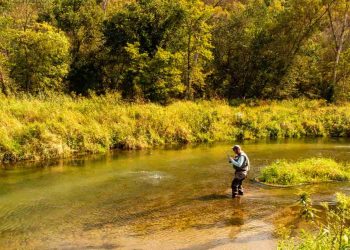
Picture by Mitch Bowers
It’s mid-January. By now, Western river passages are typically buried under a soothing blanket of white– deposit for July hatches and August dry-fly action. However this year, a look at the SNOTEL map exposes a starkly various truth: red and orange dots control the landscape, indicating a winter season that just hasn’t shown up.
According to the National Integrated Drought Information System, snow cover throughout the West is at its least expensive degree in the MODIS satellite record, which goes back to 2001. The offender isn’t always an absence of wetness, however rather an absence of cold. Unseasonably warm temperature levels have actually pressed the freezing line greater in elevation, triggering much of the season’s rainfall to fall as rain instead of snow. December temperature levels in Utah and Colorado were the hottest on record.
” Much of the western U.S. has actually begun 2026 in the middle of a snow dry spell,”reports The Conversation “That may sound unexpected, offered the record rainfall from climatic rivers striking the area in current weeks, however those storms were in fact part of the issue.”
Regional Breakdown: The Great, The Bad, and The Bare
Utah & Colorado: The Center
The circumstance is most important in the main Rockies. Snow water equivalent in Utah and Colorado is less than 60% of typical in many basins, with southwestern and western Colorado and the Upper Colorado basin of Utah struck hardest. Utah’s assistant state climatologist Jon Meyer highlighted wider issues: “We take a look at the capacity for the Olympics showing up and wishing to have respectable snow conditions for the 2034 Winter season Olympics, and years like this emphasize the threat of how environment modification is affecting snowpack in Utah.”
California: A Tale of 2 Sierras
The Golden State provides a divided image. Statewide, the snowpack is 71 percent of typical according to theCalifornia Department of Water Resources’ first survey of the season The information exposes a sharp north-south divide: the Southern Sierra is carrying out well at about 114% of typical, while the main Sierra lags at 61%. Anglers targeting the northern drains need to expect leaner circulations.
Pacific Northwest: Wet however Warm
Washington and Oregon have actually seen near-normal rainfall overalls, however the heat has actually taken its toll. According to Washington’s Department of Ecology, “For Washington water materials, there is no alternative to snow. We count on a thick snowpack to develop over winter season, and after that slowly melt in spring and summer season, feeding rivers and filling up aquifers.”
The December climatic river that discarded record rainfall in fact made things even worse. The rains melted a substantial quantity of snow in mountain watersheds, reducing the quantity of water kept in the snowpack by about 50% in the Yakima River Basin.
Montana: The Brilliant Area
If there is a silver lining, it remains in Big Sky Nation. The Flathead River basin reached a snow water equivalent of 114% of typical by January 9, with the Sun-Teton-Marias basin at 126%. Nevertheless, hydrologists explain the state as a “tale of 2 snowpacks,” with low-elevation SNOTEL stations regularly listed below 70% of typical while high elevations reveal a various pattern.
What This Implies for the 2026 Fishing Season
For fly anglers, this trajectory recommends a summertime season needing flexibility. Low snowpack traditionally associates with decreased overflow volume, earlier peak circulations, and– most seriously– greater water temperature levels previously in the summer season.
Get Ready For Early Hoot Owl Restrictions
Freestone rivers in Utah, Colorado, and the Pacific Northwest are at greatest threat. Montana Fish, Wildlife & Parks institutes “hoot owl” constraints– restricting fishing from 2 PM to midnight– when water temperature levels reach a minimum of 73 degrees for 3 successive days. Water temperature levels of 77 degrees or more can be deadly to trout. Without the sluggish release of snowmelt to cool rivers in July and August, anticipate these constraints previously and more extensively than in normal years.
Shift Your Technique
If these patterns continue through spring, anglers need to diversify their locations. Tailwaters like the Green in Utah or the Fryingpan in Colorado count on tank storage instead of instant overflow, supplying cooler, more steady circulations. High-country streams frequently remain cooler longer– this may be the summer season to trek in deep instead of drifting the huge rivers. Based upon existing information, Montana and the Southern Sierra might use the most dependable circulations come late summer season.
While late-season storms might still turn the tide, the existing deficits would need what water supervisors call a “wonder March” to balance out. In the meantime, watch on the evaluates– however begin forming your strategy B.